



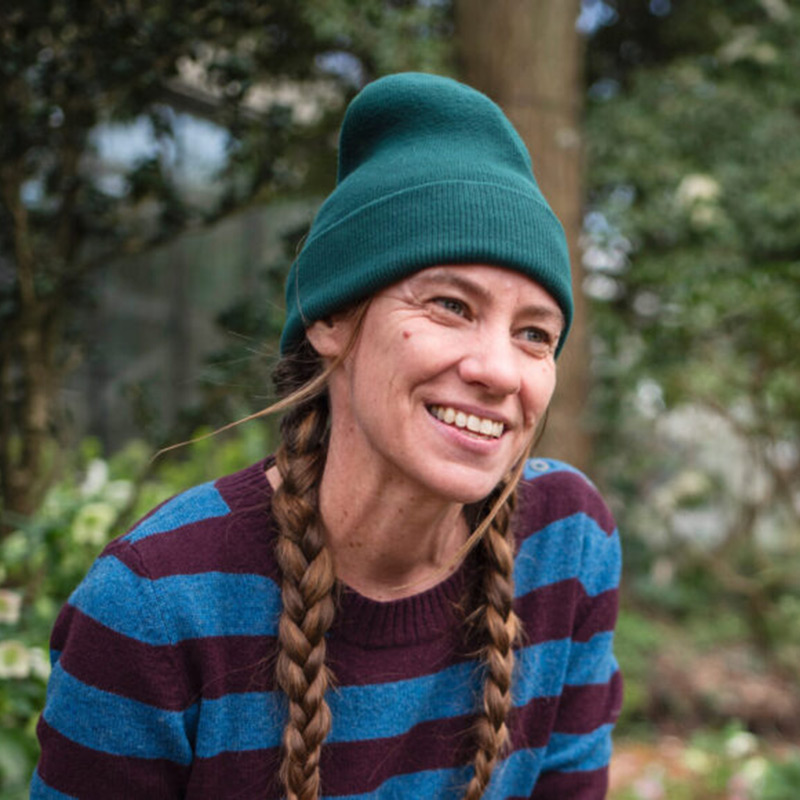
Toby Kiers: “Our understanding of fungi ushers us into a new era of connectivity”
by Paul Q. de Vries
With every new thing we discover about fungi, our astonishment grows, as we realise they’re the foundation of all life on Earth and, consequently, of our agricultural system. Toby Kiers has been studying fungi since she was 19, and last year her groundbreaking research earned her the prestigious Tyler Prize for Environmental Achievement.
Fungi are getting a lot of attention these days from both scientists and the general public. How do you explain this interest?
“Scientists have documented the amazing capabilities of fungi for decades, but for a long time they remained largely unnoticed by the public, much like fungi themselves, which are hidden underground. This is now rapidly changing: recent years have seen an influx of films, documentaries, and books on fungi. Fungi recently graced the cover of National Geographic for the first time, an IMAX film narrated by singer Björk was released, and many people mention the HBO series The Last of Us to me. That series is about fungi taking over the brains of human beings. Of course, this is purely fictional, but it is based on what Cordyceps fungi do with insects. Fungi are fascinating organisms with remarkable abilities, so it’s understandable that they captivate people’s imagination. This enthusiasm is leading to an increased interest in fungi, which I think is great.”
How do you explain this enthusiasm for fungi?
“Fungi are unique: they look like plants, behave more like animals, but belong to a distinct kingdom. They represent an unexplored frontier, a rarity in modern science. Mycologists, sometimes humorously called ‘myconauts’, explore this new frontier. We now also have the technology to capture high-resolution time-lapse footage of fungi’s activities, which helps.”
In addition, we’re discovering how crucial fungi are for life.
“Exactly, fungi are foundational to all life; their ecological impact is immense. Around 400 million years ago, fungi entered into a symbiotic relationship with plants, creating vast networks of fungal threads and plant roots called mycorrhizae. Plants provide sugars and fats to these networks through photosynthesis, while fungi supply minerals like phosphorus and nitrogen from the soil. Mycorrhizae also play a significant role in the carbon cycle, sequestering billions of tons of carbon annually. So, they’re also crucial to the climate. Fungal spores even influence cloud formation over the Amazon rainforest, to mention another example.”
Are we starting to realise how much we need fungi?
“Slowly but surely, yes. Fungi also have numerous applications that are directly beneficial to human beings. You can make furniture or bags from mycelium; the material fungi are made of. Fungi can clean up persistent pollution like oil and plastic. There’s also more research with regards to microdosing and therapies with hallucinogenic mushrooms. The possibilities are endless, which explains the buzz around fungi. But for me, as a scientist, the mycorrhizae are the most important.”
You study the transactions between plants and fungi in their underground networks. What exactly do you investigate?
“We track how nutrients are transported through the network of fungal threads and plant roots. Fungi move minerals and nutrients to areas of the network where they are scarce, to obtain more sugars and carbon in return, as scarcity drives up the price. They can also temporarily store nutrients, releasing them only when they become scarce again, thus maintaining a high price. And when there is a lot of competition, fungi behave differently, because they need to take into account that someone might overbid them, so to speak, or is willing to make a ‘deal’ for a lower price. Due to the fact that fungi exhibit this kind of economic behaviour, we use mathematical models from economics to predict what they will do next.”
This sounds like fungi are trading, even thinking entities?
“These are evolutionary strategies. For a long time, there was a lot of resistance against viewing fungi this way, but now it has become widely accepted. Fungi definitely act and make decisions. I would rather avoid the term ‘thinking’ as we associate it with organisms who have brains, which fungi do not. I always say: they are information-processing organisms, just like plants are, by the way. But in order to truly realise this, it requires a lot of rethinking. We need a new model of awareness to properly comprehend the actions of fungi and plants.”
If mycorrhizae are vital for plant life, are they also crucial for agriculture?
“Let me answer with some statistics. On healthy grasslands, fungi can make up 30 to 50 percent of the biomass. They form a network that acts like a net and prevents nutrient runoff. Plants obtain up to 80 percent of their phosphate and 30 percent of their nitrogen from their collaboration with fungi. Fungi-connected plants can expand their growing area ten to a hundred times. These plants also produce more natural chemicals to deter herbivores and insects; fungi thus help protect crops from pests. And the flowers of plants that are connected to mycorrhizae also have larger, sweeter-smelling flowers, enhancing pollination dynamics.”
Regenerative agriculture pays a lot of attention to the soil and soil life. Is this actually about fungi?
“Fungi are an essential aspect of healthy soils, alongside bacteria and insects. About 59 percent of life on Earth is underground, making it the most biodiverse habitat in the world. All that soil life is crucial for agriculture. Currently, a lot of research is being conducted on soil transplants, where soil from a forest is introduced to degraded farmland, hoping the soil life spreads and restores the land. This can take years, but it can initiate a healthy underground ecosystem. However, we must ensure that we don’t over-harvest healthy forest soil, which would be detrimental. In addition, we need to maintain diversity in soil life, as we don’t want all fields to have an identical soil life composition, because this would just mean that we are creating yet another monoculture.”
What is the state of mycorrhizae in fields where intensive, industrial agriculture takes place?
“Mycorrhizae still exist there, but they struggle. Pesticides, sometimes even fungicides that specifically target fungi, artificial fertilisers, mechanical tilling; they are all harmful to fungi. Therefore, what we see is that in these places, fungal networks are sparser, thinner and less diverse than in natural soils. Fungi do produce more spores there, due to the pressure to reproduce quickly. The worst effect is that artificially fertilised plants no longer depend on fungi for nitrogen, therefore ceasing to trade carbon. In the Netherlands, this effect persists even without artificial fertilisation, as the nitrogen levels that circulate in the environment are so high. It can even be found in the rain.”
What should farmers do who want to support ‘their’ fungi?
“Mostly, it’s about the things they should avoid: fertilisation, pesticide use, and ploughing the soil. There is a lot of talk about strips of flowers or hedgerows on the sides of fields. These are both beneficial for the biodiversity above the ground, but also act as a reservoir from which fungi can recolonize the fields. Most importantly, we need to realise that our food comes from a system where fungi play a crucial role. Therefore, farmers should embrace stewardship of the soil, paying as much attention and care to the invisible life in the soil as to their crops above the ground.”
How can science assist farmers?
“Currently, farmers only have access to tools that are fairly blunt. You can buy a pot of fungi from a wholesaler to inject into your land, but these are mostly commercial products that are yet to be proven effective. Or worse, these products could even drive away existing fungi. Therefore, we need to return to basics: managing land in such a way that existing fungi and other soil life can thrive. How this works is what we study in various global projects with our non-profit SPUN (Society for the Protection of Underground Networks). For example, in Ecuador, we investigate how fungi from surrounding forests spread to small-scale farmers’ fields and in the Atacama Desert in Chile, we study how fungal networks enable the local population to farm in these harsh surroundings. We also take soil samples to see which fungi and networks are active in these places.”
Letting fungi do the work: this sounds like a completely different approach to farming.
“Farmers have long seen fungi as pests or diseases that they need to protect their crops from, which is understandable given that many fungi can devastate crops. But the value of mycorrhizae is undeniable. We should cultivate and select crops to optimise their collaboration with fungi, yet we do the opposite, often resorting to artificial fertilisers. We used to think of healthy soils mainly in terms of their physical structure. Now we recognize the importance of soil life and underground biodiversity. There is much to learn and discover in this area. But one thing is certain: farmers of the future will join forces with their fungi.”
Fungi show us how interconnected life on Earth is. Does this insight have consequences that extend beyond agriculture?
“Absolutely. We used to study nature by categorising everything into separate groups; everything with similar characteristics was grouped together. But now we realise that the interconnectedness of life forms is far more intricate than we thought. Therefore, we should no longer think in terms of individuals, or even in terms of individual species, but in relationships. This perspective should shape our overall view of nature, including our own role within it. You could say we are entering a new era of connectivity.”
This article was originally published on We Are The ReGeneration.

























Comments
Sign in to post a comment.