



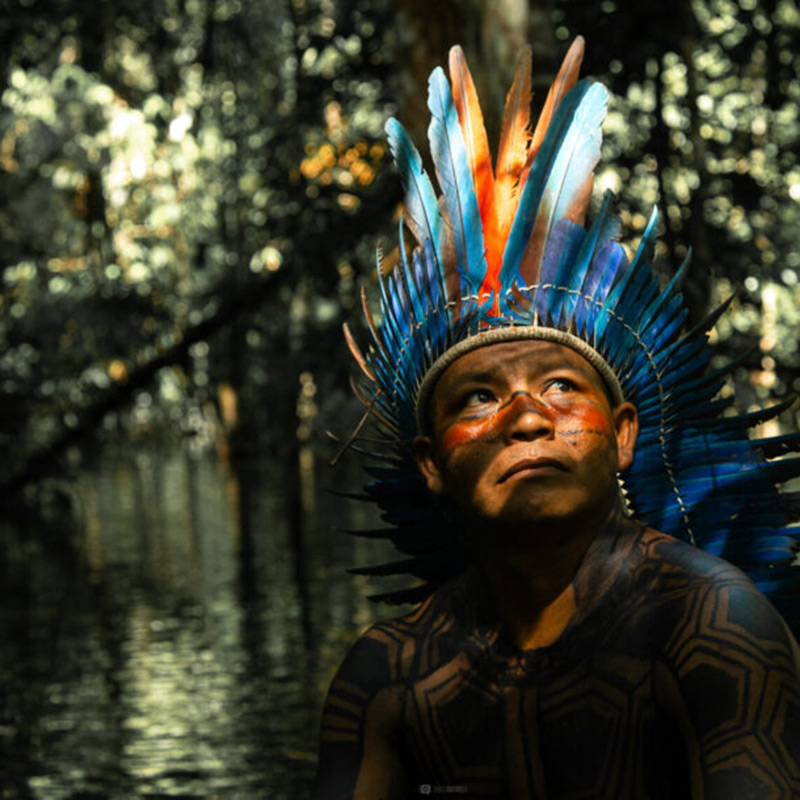
“Now the law is my bow, justice is my arrow and GPS cameras help us gain access to the legal system”
by Nadine Maarhuis
Indigenous leader Odair Dadá Borari – better known as Dadá – grew up in the heart of the Amazon rainforest. To save the ecosystem that supports all life on Earth, he teamed up with Dutch criminologist Tim Boekhout van Solinge. Together, they train and equip indigenous forest guardians to leverage modern technologies and put a stop to illegal deforestation. “I know when the forest cries for help”, says Dadá. “We need to respect her boundaries.”
Dadá, you were born in the Amazon rainforest in 1981. Can you describe your childhood?
“I grew up in the middle of the pristine forest, in the Maró area in the Pará state in Brazil. The birds taught me how to sing, the trees were my playground and the river was my swimming pool. I didn’t know anything about video games, but during those early years I uncovered the lessons that still guide me today. The trees are my family; I know when the forest cries for help and when Mother Earth weeps. But above all, I learned that nature is finite and that we must respect her boundaries.”
How did you learn this lesson?
“When I was thirteen, my people chose me as their future leader. For the first time in my life, I left the rainforest to go to school and learn how to read and write. After a year, I returned for the second part of my education. My great-grandfather, grandfather and father took me under their wing. Together, we lived in the forest for three months, with only a bow and arrow to survive, and whilst we moved around, they taught me everything they knew.
One day, we encountered a group of wild pigs. As I aimed for the largest one, my elders made me realise I should go for the smallest one, as we would never be able to eat all the meat, and the largest one was the mother, raising the others. I’ve always remembered that moment. It taught me to be humble and to never take more than you need.”
How do you and the Dutch criminologist Tim Boekhout van Solinge work together to protect the Amazon from deforestation?
“In the past, we would only have our bow and arrow to defend the forest. Since we’ve been working with Tim, we know that there is a constitution that protects our lives, and thereby protects the forest. Now the law is my bow, justice is my arrow and GPS cameras help us gain access to the legal system.” Tim, how did you come up with the idea of using GPS cameras in the Amazon rainforest?
“As a criminologist, I’ve been studying violent conflicts and organised crime for years. I would write about these topics and advise governments on them, but at one point, I realised: I am only dealing with the problems whilst I want to be working on the solutions. After spending a prolonged period of time in the Amazon and talking to many indigenous people who are trying to protect the forest, I came up with the idea of using GPS cameras. This may sound futile, but the approach is highly effective, because it promotes justice, gives indigenous people access to the legal system and protects nature at the same time.”
Can you expand on this?
“When I discussed the idea of GPS cameras with the Brazilian Public Prosecutor’s Office, they immediately were on board because they need GPS coordinates of illegal deforestation sites and images of the perpetrators to be able to prosecute them: GPS cameras provide both. And the Public Prosecutor’s Office is actually one of the few non-corrupt institutions in Brazil that is genuinely committed to tackling deforestation. But they simply need evidence, and these GPS cameras provide it.”
“At the same time, it’s crucial that indigenous people get access to the rule of law and the justice system. Many NGOs want indigenous people to talk to those who are responsible for illegal deforestation, but indigenous leaders rightly say: ‘We are not going to negotiate with people who send assassins after us.’ Because that is the reality: indigenous people defend the areas where they have lived for thousands of years, and where they protect 80 percent of the world’s remaining biodiversity, literally with their lives. By capturing illegal deforestation on camera and sharing these images with the Public Prosecutor’s Office, indigenous people now finally have a way to protect their lives and the ecosystems they call home, and therefore a means to save this precious ecosystem that is crucial for all life on Earth.”
How did you get in touch with Dadá?
“In 2013, I was looking for indigenous communities willing to work with the GPS cameras. Because I realised: I might think it’s a good idea, the Public Prosecutor’s Office might think it’s a good idea, but the indigenous people are the ones who actually have to use the cameras. Through a local priest, I discovered that Dadá had already created a team of so-called forest guardians. They even already looked into GPS systems, but lacked access to the technology. I gave him a GPS camera and said: ‘I don’t want anything in return, apart from some digital copies.’ For me it was purely a test to see if it would work. Would the forest guardians be able to capture the illegal deforestation on camera? Would the photos subsequently reach the Public Prosecutor’s Office and would they act upon it? To my astonishment, all these things did happen, so Dadá and I decided to continue down this path together.”
Currently, the forest guardians use the GPS cameras to protect over 150,000 hectares of forest. How did you and Dadá achieve this?
“Transparency is key. Dadá and I respect each other’s cultures and share everything without hidden agendas, as I do with my other colleagues. Too often, people think: ‘He is indigenous and lives in the forest; he is different.’ But we are all part of the same human family.
Furthermore, Treesistance – the NGO we started for our collaboration – is one of the few organisations that works entirely based on what indigenous people need. For example, initially the forest guardians had to walk hours back and forth to the generator each time the cameras had run out of battery. So we developed small solar panels, allowing the cameras to function entirely off-grid. For us, it’s all about enabling those who protect the forest.”
Dadá, what do you need most to make a bigger impact?
“Right now, we mainly need funding for more equipment, such as GPS cameras and solar panels, but also vehicles like cars, motorcycles, and boats. The distances we cover to distribute the GPS cameras across different indigenous communities are enormous. Often, we drive through the forest for two days straight without encountering anyone, in very old vehicles. This is dangerous because if you break down, you have nowhere to go, and the loggers will find you. Therefore, we often rent vehicles to get around, but this is costly and delays our work.
In addition, it’s crucial that people generate more awareness about what we do. Our fight has to reach the media so that people – for instance, in Europe – discover how their way of living directly influences deforestation.”
Tim, what role does your home country, the Netherlands, play in this?
“In 2003, I visited Santarém, a port city in the Amazon. I arrived by boat and saw piles of logs everywhere. Nowadays they don’t leave the wood out in the open anymore, but back in the day they still did. Whilst I was taking photos, I was shocked to see that Vlissingen – a Dutch port town – was the number one destination for all that tropical wood.
Moreover, there is the meat industry. Vast areas of the Amazon are burned down to make room for grazing cattle and soy plantations for animal feed. And the Netherlands is the largest importer of soy for animal feed in Europe. It also has the highest livestock density in Europe, so the connection is clear. In other words, because the Dutch choose factory farming, there is deforestation in the Amazon every single day.
Then there are pension funds like ABP and banks like ING, Rabobank and ABN Amro, who respectively invest millions and billions in companies responsible for deforestation. So the Netherlands is deeply involved as a major investor and consumer of these products.”
If the problem is so multi-faceted, can we solve it? Dadá, are you hopeful about the future?
“The world must support those who protect the forest. It’s that simple. If that happens, we can protect our home and keep the planet liveable. But we cannot do it alone. We need everyone, including those who have never been to the Amazon, but yet have a relationship with the forest and can positively influence it through their daily choices.”
This article was originally published on We Are The ReGeneration.

















Comments
Sign in to post a comment.